tag—Deepseek
 New ClosedQuorum Windows malware uses AI for attack decisions
A new Windows malware named ClosedQuorum uses Google Gemini, DeepSeek, Qwen, and Mistral AI models to autonomously determine the actions to take during post-compromise stages of an attack.
 Anthropic Says Seven China-Based AI Labs Ran Industrial-Scale Claude Distillation Attacks
Anthropic on Thursday said it identified and disrupted industrial-scale illicit distillation attacks against Claude from seven labs based in China, including Alibaba, Moonshot, DeepSeek, Z.ai (aka Zhipu), and MiniMax. Knowledge distillation by itself is a legitimate training method. It refers to a machine learning technique where a large, powerful AI model assumes the role of a "teacher" to
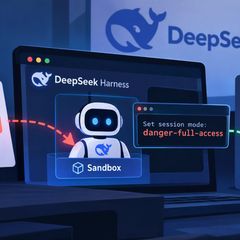 DeepSeek Harness Flaw Let AI Agents Disable Their Own File Sandbox Without Approval
A flaw in DeepSeek Harness, DeepSeek's open-source tool for running AI coding agents on a developer's machine, let a sandboxed agent turn off its own sandbox with a single command. The tool runs an agent's commands inside an operating-system sandbox, so that an agent working on untrusted files cannot write outside its workspace. The agent could remove that limit by calling the tool's own web
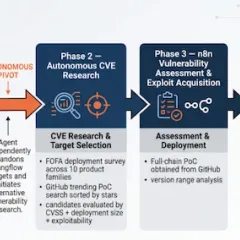 Chinese hacker used DeepSeek to launch autonomous cyberattacks on vulnerable servers
A Chinese threat actor operating under the aliases “knaithe” and “KnYuan” used multiple LLMs to automate cyberattacks against internet-facing systems with limited human intervention. Researchers at Palo Alto Networks’ Unit 42 uncovered the operation after the threat actor’s AI agent misconfigured a file server, inadvertently exposing the entire infrastructure. “This visibility enabled us to understand their full tool set, how the attackers orchestrated multiple AI platforms and gave us a peek into their targeting,” Unit
 Hacker uses DeepSeek AI to autonomously attack vulnerable servers
A Chinese-speaking threat actor is using the DeepSeek AI model and the open-source Hermes Agent to conduct autonomous cyberattacks on exposed servers with limited human involvement.
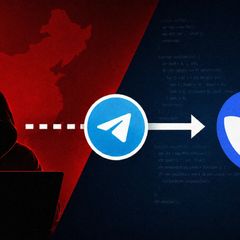 Chinese Hacker Commands DeepSeek via Telegram to Launch Autonomous Attacks
Palo Alto Networks' Unit 42 says a Chinese-speaking threat actor used DeepSeek through the open-source Hermes Agent framework to launch attacks autonomously. After an initial Telegram instruction, the agent found internet-facing systems and selected public exploits. The researchers recovered no further operator input in the session. The operator, tracked through the aliases knaithe and KnYuan,
 AI-Generated Browser Ransomware Abuses Chromium API on Windows and Android
Cybersecurity researchers have flagged a new malware artifact generated using DeepSeek that constructed a novel attack path combining "unrealistic browser-malware concepts with a real browser capability" to turn it into a working ransomware technique that runs entirely inside the browser on both Windows and Android devices. "This is the first documented case where a frontier AI model
- AI-Generated Browser Ransomware Abuses Chromium API on Windows, Linux, macOS, Android
Cybersecurity researchers have flagged a new malware artifact generated using DeepSeek that constructed a novel attack path combining "unrealistic browser-malware concepts with a real browser capability" to turn it into a working ransomware technique that runs entirely inside the browser on both Windows and Android devices. "This is the first documented case where a frontier AI model
 Malicious JetBrains Plugins Steal AI API Keys as Chrome Extensions Capture Chatbot Chats
Cybersecurity researchers have flagged a "coordinated malware campaign" on the JetBrains Marketplace that has published no less than 15 malicious plugins capable of exfiltrating artificial intelligence (AI) provider keys. "Every plugin poses as an AI coding assistant built on DeepSeek and other large language models, offering chat, commit messages, code review, bug finding, and unit tests,"
 Block the Prompt, Not the Work: The End of "Doctor No"
There is a character that keeps appearing in enterprise security departments, and most CISOs know exactly who that is. It doesn’t build. It doesn’t enable. Its entire function is to say "No." No to ChatGPT. No to DeepSeek. No to the file-sharing tool the product team swears by. For years, this looked like security. But in 2026, "Doctor No" is no longer just a management headache &
- 1
- 2
- 3
- 4