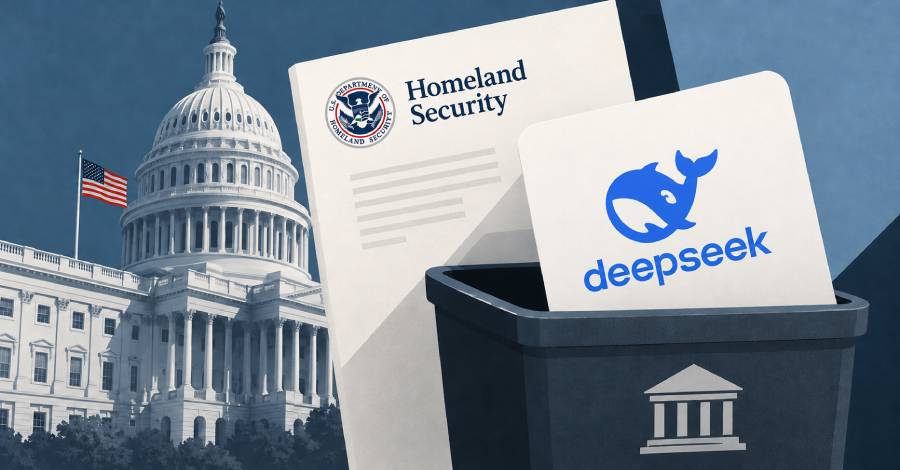
U.S. federal civilian agencies must remove DeepSeek products from their information technology systems, along with any third-party products or services "developed using DeepSeek implementations," under a Department of Homeland Security order.
They may also no longer buy information technology products or services from the Chinese AI developer or its affiliates
Homeland Security Secretary Markwayne Mullin issued the order, dated July 24, 2026, under the Federal Acquisition Supply Chain Security Act of 2018, and the department published it in the Federal Register on October 20. The notice does not define "DeepSeek implementations."
The order names Hangzhou DeepSeek Artificial Intelligence Co., Ltd., the developer of the R1 and V3 models, and covers its affiliates as defined in federal acquisition rules. The company's privacy policy says it collects, processes and stores users' personal data in the People's Republic of China.
Under the 2018 law, the Federal Acquisition Security Council recommends exclusion and removal orders, and three officials may issue them: the Secretary of Homeland Security for civilian agencies, the Secretary of Defense for the Defense Department and national security systems, and the Director of National Intelligence for the intelligence community.
The DeepSeek order therefore covers only what civilian agencies buy and run. It does not restrict companies or the public.
The 2018 law was first used in 2025, when the Director of National Intelligence excluded Acronis, a Swiss cybersecurity and data protection company, from intelligence community procurement and ordered its products removed from intelligence community systems.
Executive agencies "shall comply with exclusion and removal orders," the law says. An agency can ask the official who issued an order for an exception, and under the council's regulations the request must be in writing and give a compelling justification.
DHS directs questions about the order to CISA's FASCSA Order Implementation Team at [email protected].
The order also reaches government contractors. A federal contract that carries FAR clause 52.204-30 bars the contractor from providing or using, in performing the contract, any product or service covered by an applicable FASCSA order, unless the issuing official has granted a waiver.
The clause also requires the contractor to:
- Search SAM.gov for the phrase "FASCSA order" at least once every three months
- Make a reasonable inquiry into its supply chain when a new order could affect it
- Report any covered product or service it has provided or used to the contracting officer within 3 business days of identifying it
- Send further information on mitigation within 10 business days of that report
- Include the clause in its subcontracts
An order issued after a solicitation applies to an existing contract only once the contracting officer adds it by amendment or modification.
The Federal Register notice gives no reasons for the order. The signed order is attached to the notice as four scanned pages and is posted on regulations.gov under docket DHS-2026-0628.
The order is dated July 24. DHS filed it for public inspection at the Federal Register on October 19, 87 days later, and it was published the next day.
The council's regulations leave public release of an order to the issuing official, who "May provide a copy of the order to other persons, including through public disclosure." They set no deadline for it.
The law requires the issuing official to notify the company named in an order and the appropriate congressional committees, and to review the order at least once a year.
Before the order, U.S. restrictions on DeepSeek were device bans adopted one body at a time. By February 2025, Congress, NASA, the Navy, the Pentagon and Texas had barred DeepSeek from government devices. Bills to bar DeepSeek on government devices were introduced in the House and Senate that month and had not advanced past committee as of October 21.
China's foreign ministry spokesperson Mao Ning said at a briefing on October 20 that "China consistently opposes the overstretching of the concept of national security" and that Beijing will "resolutely safeguard the legitimate rights and interests of Chinese companies," the Associated Press reported. DeepSeek did not immediately respond to the AP's request for comment.