Authorities in Germany and the U.S. dismantled the central infrastructure of Kratos, a phishing-as-a-service (PhaaS) platform with global reach, and its developer was arrested in Indonesia.
During the operation, authorities seized more than 200 servers, effectively disrupting the malicious service and rendering it inoperable.
The action was led by Frankfurt’s Prosecutor General Office (ZIT), Germany’s Federal police (BKA), which worked in collaboration with U.S. law enforcement agencies.

BKA’s announcement characterizes Kratos as “one of the world’s most widely used criminal phishing services,” with confirmed victims across 35 countries, particularly in Europe and the United States.
“Authorities believe that more than 1,800 criminal customers purchased Kratos and used it to conduct roughly 15,000 phishing campaigns per month,” BKA announced.
“Each campaign had the potential to affect several thousand recipients worldwide.”
The phishing toolkit, which allowed threat actors to create and manage fake Microsoft authentication pages, was rented to cybercriminals for phishing attacks.
The kit provided convincing login forms designed to steal email addresses and passwords, enabling the attackers to hijack Microsoft accounts.
Access to these accounts was often leveraged to “commit further crimes,” states BKA, hinting at post-compromise activity such as business email compromise, data theft, account takeover, and phishing attacks targeting the victims’ contacts.
The authorities estimate that the owner of the service made at least €300,000 ($342,000) since 2024, from subscription fees to the Kratos platform.
With the arrest of the technical administrator and the shutdown of key parts of its infrastructure, BKA states that these phishing campaigns can no longer continue.
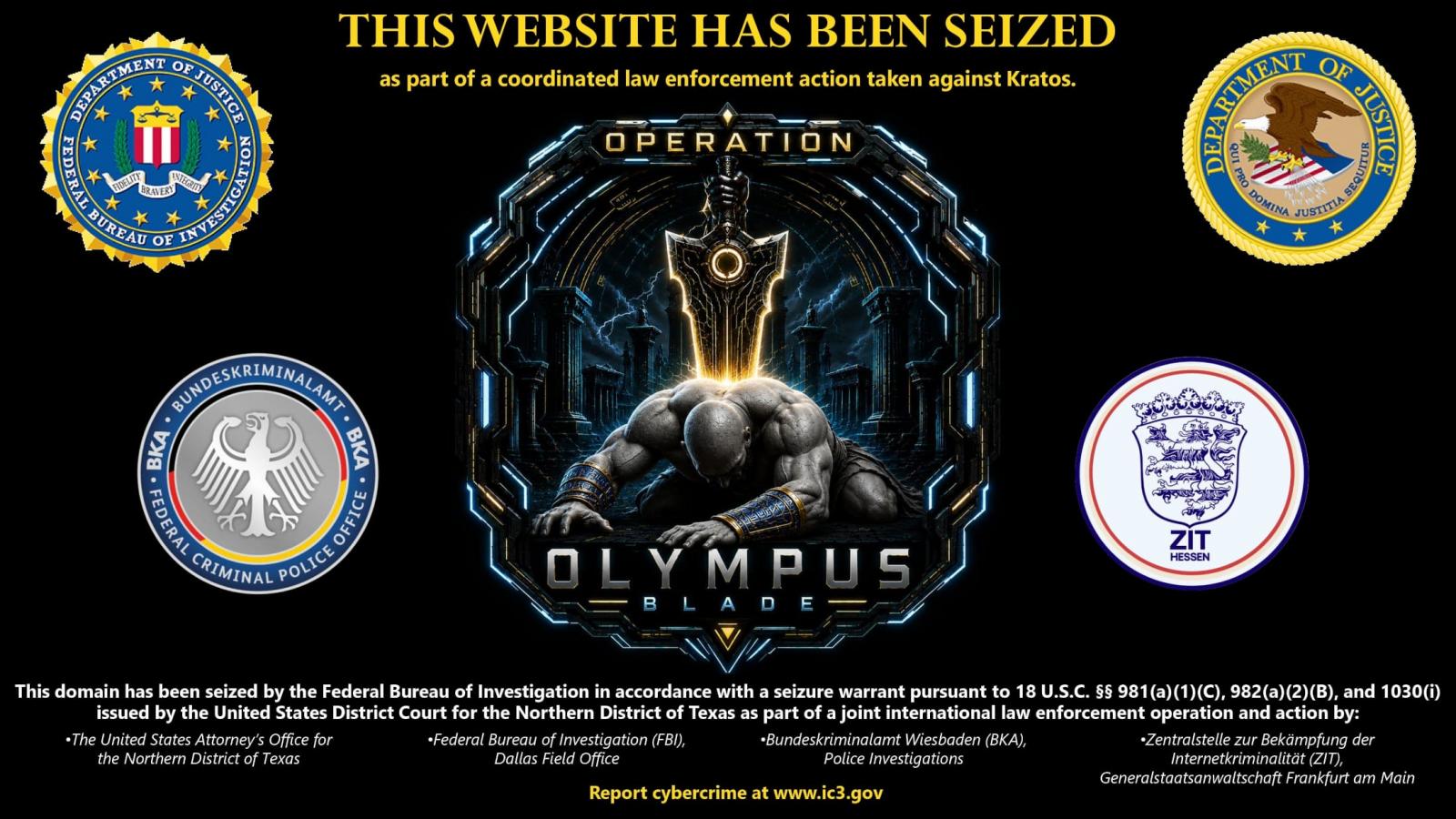
A seizure banner was added to the service’s website, presenting the action as part of Operation Olympus Blade and stating that domain ownership has now been transferred to the FBI.
With the servers seized, authorities can further the investigation by retrieving new forensic evidence that may lead to the identification of customers of the service.
Test every layer before attackers do
Security teams log 54% of successful attacks and alert on just 14%. The rest move through your environment unseen.
The Picus whitepaper shows how breach and attack simulation tests your SIEM and EDR rules so threats stop slipping by detection.
Get the whitepaper