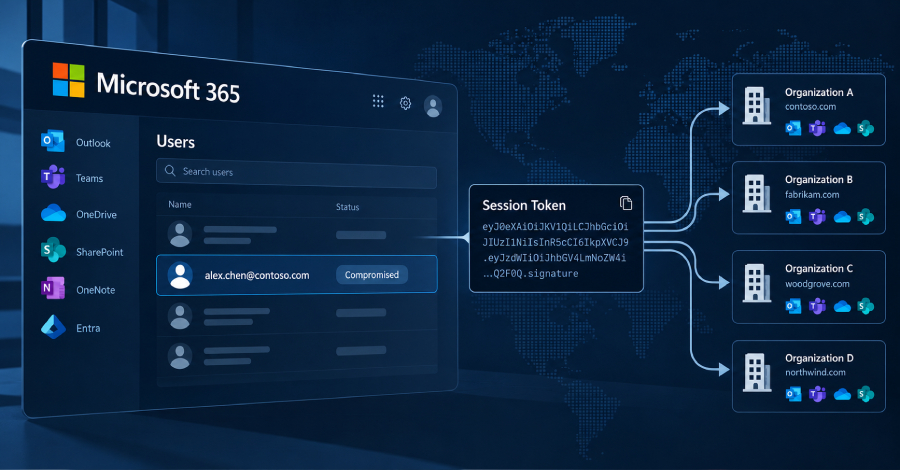
Cybersecurity researchers have disclosed a Microsoft 365 campaign that has been observed leveraging an adversary-in-the-middle (AitM) relay to capture sign-in sessions and then replay the stolen tokens to break into email accounts at 79 organizations.
Huntress, which observed the activity between July 14 and September 22, 2026, said it detected 497 successful Microsoft 365 sign-in events across the victim organizations from over 200,000 login attempts, with the attackers ultimately compromising 97 accounts and registering 48 rogue Entra devices.
"Rather than guessing passwords, the attacker replayed sign-in tokens stolen from victims, and we've traced more than 200,000 failed login attempts from the campaign window back to the 193.26.115[.]0/24 IP range," Huntress researchers Andrea Hatcher, Susannah Matt, Matt Poto, and Andrew Schwartz said.
The attack has been found to employ an AitM login page, which sits between the victims and legitimate Microsoft infrastructure to capture the entered credentials and MFA codes and relay the information to the real login page.
The end goal is to collect the access token issued by Microsoft following the sign-in process so that it doesn't have to bypass MFA a second time. The "proof of login" token is subsequently replayed by the attacker from their own devices within minutes to conduct automated sign-in attempts against Microsoft 365 services.
The approach has been codenamed token spraying, as it involves the attacker replaying many stolen tokens at scale across several organizations in a manner that's analogous to password spraying.
Upon gaining successful access, the attackers moved to add their own authenticator app as a form of persistence to complete MFA challenges for new sign-ins and overcome scenarios where the stolen session token expires or gets revoked by the victim.
In no less than 19 organizations, the victim's existing MFA methods were removed and a new method registered within three hours of the first sign-in. In one case observed on July 21, 2026, the threat actors activated a new authenticator app named "iPhone 13" less than 51 minutes after the session was hijacked.
"Rogue devices served the same purpose," the researchers said. "The threat actor registered at least 48 fake computers in victim organizations' Microsoft directories. A registered device can give the attacker a more durable way to request tokens than the stolen session alone, and it stays in the directory until someone deletes it."
Furthermore, the attackers have also been spotted setting up hidden email rules in victims' inboxes with names such as ".," "sss," "ss," "iT," ",.," "........," "s," and "d" to delete incoming mail with certain keywords referencing payroll, deposit, and bonus, or move them to obscure folders like RSS Feeds and Conversation History.
In one compromised mailbox, the email rule marked all incoming messages as read and deleted them. The mailbox was then used to send outbound spam to hundreds of external recipients before Microsoft Entra ID Protection rated the account high risk.
Huntress said the tokens originate from multiple sources, including AitM relays behind fake sign-in pages, device-code phishing, and social engineering during a legitimate login process.
The campaign was first observed from a Romanian IP address "193.26.115[.]221," which, according to VirusTotal, is used by a remote access trojan called AsyncRAT. The IP address is associated with a German hosting provider named 1337 Services GmbH.
Data from GreyNoise currently lists 29 IP addresses matching the hosting provider, out of which 10 have been flagged as malicious and five are marked suspicious. Notably, the entity is linked to StarkRDP and rdp[.]sh, which allows paying customers to rent virtual servers.
The domains linked to both StarkRDP and rdp[.]sh were taken down, alongside websites for Nulled, Cracked, and Sellix, as part of an international law enforcement operation dubbed Talent in January 2025. As of writing, the two platforms are operational, with the former now rebranded as exy[.]sh.
"StarkRDP has always been operating by the law and is not involved in any of these alleged crimes, and the legal process will confirm this," the StarkRDP Telegram account said in a post dated January 30, according to independent cybersecurity journalist Brian Krebs.
"The only things that were seized is [sic] the website server and our domain. Unfortunately, no one can tell who took it and with whom we can talk about it. Therefore, we will restart operation soon, under a different name, to close the chapter [of] 'StarkRDP.'"
Organizations who suspect a token replay compromise are recommended to revoke sessions and reset the password, audit Entra devices, review MFA methods, check for unexpected inbox rules or new enterprise applications, and restrict device-code workflow with Conditional Access policies.
"Conditional Access Policies (CAP) can help fill some of the security gaps that MFA can't, as long as they're appropriately implemented," Huntress researchers said. "Businesses setting up CAPs should require MFA (or block) for All Users, All Cloud Apps, and All Client App types, unconditionally."