Your Purple Team Isn't Purple — It's Just Red and Blue in the Same Room

Defending a network at 2 am looks a lot like this: an analyst copy-pasting a hash from a PDF into a SIEM query. A red team script is being rewritten by hand so the blue team can use it. A patch waiting on a change-approval window that's longer than the exploitation window itself.
Nobody in that chain is incompetent. Every human is doing their job correctly. The problem is the system, its workflows, and its messy handoffs.
In contrast, the attacker's clock has nearly disappeared.
In 2024, the mean time from a CVE being published to a working exploit was 56 days. By 2025, it had shrunk to 23 days. So far in 2026, it’s sitting at roughly 10 hours across 3,532 CVE-exploit pairs from CISA KEV, VulnCheck KEV, and ExploitDB.
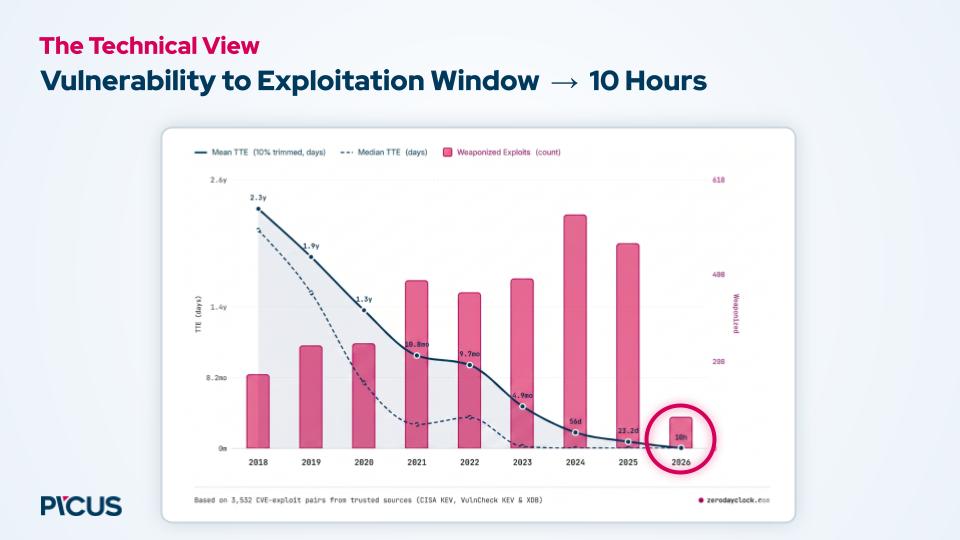 |
| Figure 1. Today’s Vulnerability to Exploitation Windows is now 10 Hours |
The minor piece of good news is that the defender's clock has accelerated to run in hours. The really bad news is that the attacker's clock has leapfrogged past it and now runs in seconds. It’s not even close to a fair fight.
For a decade, the security industry has had a name for the practice that's supposed to close this gap: purple teaming. It's the right answer. It just hasn't been a practical one, until now.
What Purple Teaming Actually Is
Purple teaming is simple in concept.
Red finds the paths an attacker would take. Blue validates whether detections fire and prevention holds. They iterate. Red's output becomes blue's input. Blue's output becomes red's next input. The loop tightens your organization’s posture continuously instead of once a quarter.
That's the idea, and again, it’s a solid one. The execution is where, sadly, it all falls apart.
Three Reasons that Traditional Purple Teaming Hasn’t Been Operationalized
Reason 1: Human purple teaming creates too much friction.
Almost nobody runs purple teaming as a real loop. The teams don't talk often enough;and when they do, people get pulled into long meetings, detailed reports, lengthy post-mortems, and family emergencies. The bottleneck is almost always human, in the most ordinary sense.
Look at where defender hours actually go.
- Not inside the EDR — it fired.
- Not inside the SIEM — it correlated.
- Not inside the scanner — it had the CVE.
Response time dies in transit. The unread Slack message. The copy-pasted hash. The PDF was emailed for review. The ticket waiting for eyeballs or approval. The red team script is being rebuilt by hand for the blue team. This is the spaghetti handoff. Once you see the inefficiencies and failure points, you can't unsee them.
Reason 2: Orchestrating teams and tools is the real bottleneck
The network team owns firewalls. The SOC consumes alerts. Red runs exercises. Blue builds detections. VM chases CVEs. IT ops applies patches.
Each group operates one or more tools; each tool emits an artifact (a finding, an alert, a report, a ticket) that gets picked up, reinterpreted, and handed off. What these teams collectively produce is meant to be a service: a continuously validated security posture. In reality, it's usually a jury-rigged mess, glued together by overtaxed humans typing bleary-eyed into Jira at midnight.
So purple teaming has largely stayed aspirational. A cool idea in vendor decks. Perhaps a quarterly exercise. Almost never operational. Certainly not operational enough.
Reason 3: Traditional purple teaming can't keep up with AI-powered adversaries
Here's what’s changed. Attackers got an LLM. The defenders are still filling in a Jira ticket.
For most organizations, the change-approval process alone is now longer than the exploitation window.
An AI-assisted attacker can compromise a system in 73 seconds. A defender, working through the standard handoff chain between SOC, red and blue teams, and IT, usually takes at least 24 hours to deploy a fix.
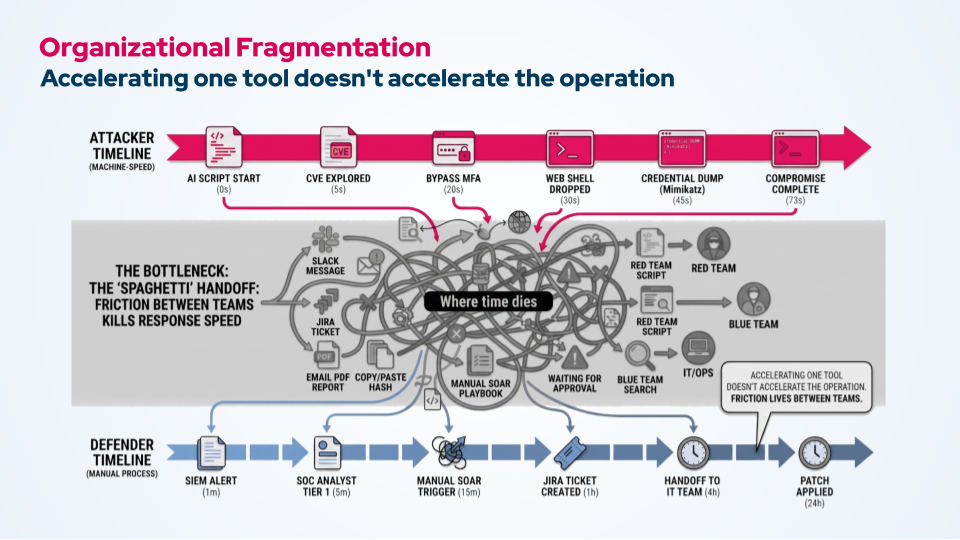 |
| Figure 2. Spaghetti Handoff between teams |
A quarterly purple team exercise, or even a monthly one, isn't a loop anymore, it’s a box to be checked, a snapshot of a battle that's already happened, and, usually, an exercise in futility.
Enter Autonomous Purple Teaming
The same technology compressing the attacker's clock can compress the defender's.
The good news is that autonomous purple teaming, by its very nature, is exactly the kind of workflow AI is good at: a tight, well-defined loop between two specialized functions, where the bottleneck has always been the human handoff and knowledge transfer rather than the work itself.
When autonomous agents run the handoffs, the loop finally closes at machine speed.
- Red's findings automatically become blue's tests.
- Blue's gaps become red's next exercise.
- No coffee breaks, no kids home from school, no holiday disruptions.
The system people have been describing for ten years can now finally run as an ongoing methodology, not a calendar event.
This isn't "AI for security" in the sense most vendors have pitched over the last year: generate a YARA rule, summarize an alert, draft a ticket. Those are task automations. Useful, and incrementally helpful. But true autonomy is something else: an agent running the entire loop end-to-end, with every step auditable so you can override, retune, or roll back.
And it's a dial, not a cliff. Crawl is manual. Walk is scheduled with AI assist. Run is end-to-end with human review only where needed.
What Autonomous Purple Teaming Looks Like in Practice: BAS, Automated Pentest, and AI-Powered Mobilization
To be effective, autonomous purple teaming requires three components working as one system rather than separate tools:
Automated Penetration Testing is red's question, answered continuously: can an attacker reach the crown jewels in your environment, given today's exposures and today's controls?
Breach and Attack Simulation (BAS) is blue's answer: did the firewall block it, did the EDR catch it, did the SIEM rule fire, did the response play out the way the runbook says it should?
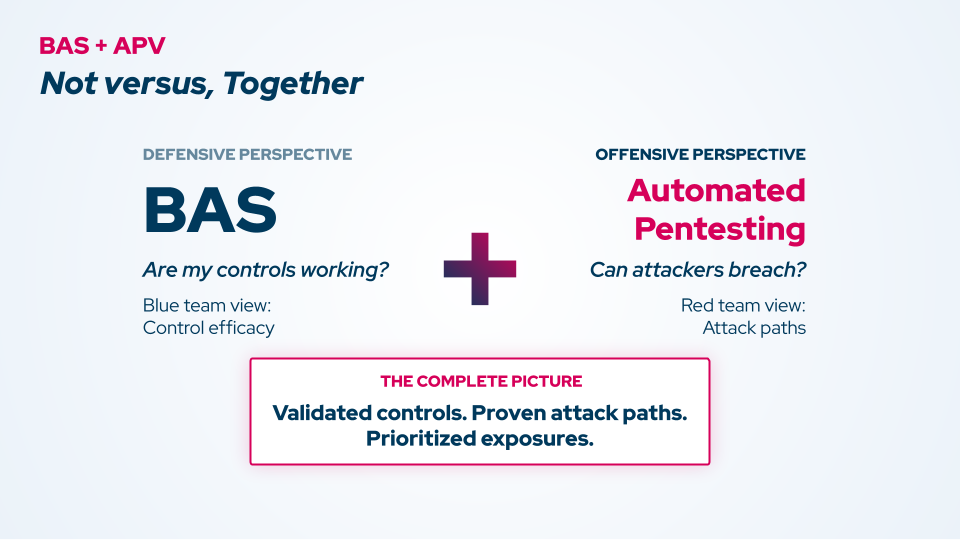 |
| Figure 3. BAS and Automated Pentesting gives you the complete picture |
AI-powered mobilization is the part that used to be a human typing into Jira, now run by a chain of specialized agents. A CISA alert lands. A CTI agent enriches it against your environment. A baseliner agent decides the threat is relevant and pulls the current posture from BAS, pentest, and exposure data. Red and blue agents run the simulation and validation in parallel. A mobilizer agent auto-deploys low-risk fixes, opens tickets for the moderate ones, and flags the rest for human review. A reporter agent writes one executive view for leadership and one technical view for the SOC.
No analysts in the chain. Every step is still visible in the operator console. No black box, just no humans in the typing-into-Jira seat.
The output isn't 50,000 CVEs ranked by CVSS. It's one continuous action queue across red and blue: what's actually exploitable today, against your actual controls, and what to do about it before the exploitation window closes.
That's purple teaming, not just automation. It's the loop the industry has been dreaming about, finally running at the pace AI-powered threats now demand.
See it running inside a real enterprise
A continuous loop is the right answer. But "continuous" still implies a human pacing it. When attackers operate at machine speed, the gap that matters isn't between seeing and detecting; it's between detecting and proving fast enough that an AI-driven adversary doesn't find out first.
This is where validation goes from continuous to autonomous: AI agents reading the alert, scoping the test, running the simulation, pushing the fix, and writing the report, while the SOC focuses on the big picture, and ideally catches up on some much-needed sleep.

We'll be unpacking exactly what this looks like — the architecture, the agentic workflows, the operational reality of running this inside a real enterprise — at the Autonomous Validation Summit on May 12 & 14, hosted with Frost & Sullivan and featuring practitioners from Kraft Heinz, Hacker Valley, and Glow Financial Services, alongside Picus CTO Volkan Erturk.
Note: This article was written by Sıla Özeren Hacıoğlu, Security Research Engineer at Picus Security.
source: TheHackerNews