The cybersecurity industry has spent decades assuming that offensive capability scales with technical expertise.
That assumption is starting to break.
Security teams have long estimated risk by ranking attacker sophistication. Nation-state actors sat at one end. Organized criminal groups followed. Inexperienced attackers, dismissed as "script kiddies," sat at the other end, running public tools they didn't fully understand.
Generative AI is collapsing that ranking.
The next generation of attackers won't necessarily bring years of exploit development or reverse engineering experience. Instead, they'll use AI to close knowledge gaps by accelerating research, explaining unfamiliar concepts, generating code, troubleshooting errors, and adapting known techniques to new environments.
The barrier to entry is dropping fast.
The Economics of Cyberattacks Are Changing
Every major technology shift changes economics as it changes the solutions we rely on.
Cloud computing cut the cost of building infrastructure. Open-source software cut the cost of developing applications. LLMs are cutting the cost of offensive security knowledge.
An attacker who once needed weeks to understand a newly disclosed vulnerability can now use AI to summarize technical documentation, explain exploit mechanics, identify affected technologies, and generate prototype code in minutes.
That doesn't necessarily mean AI independently discovers sophisticated attack chains or replaces experienced operators. Complex intrusions still demand expert judgment, creativity, and persistence.
What's changed is how much expertise it takes to get operational. The result is a larger population of more capable attackers.
From Script Kiddies to AI Collaborators
The term "script kiddie" no longer captures what's happening.
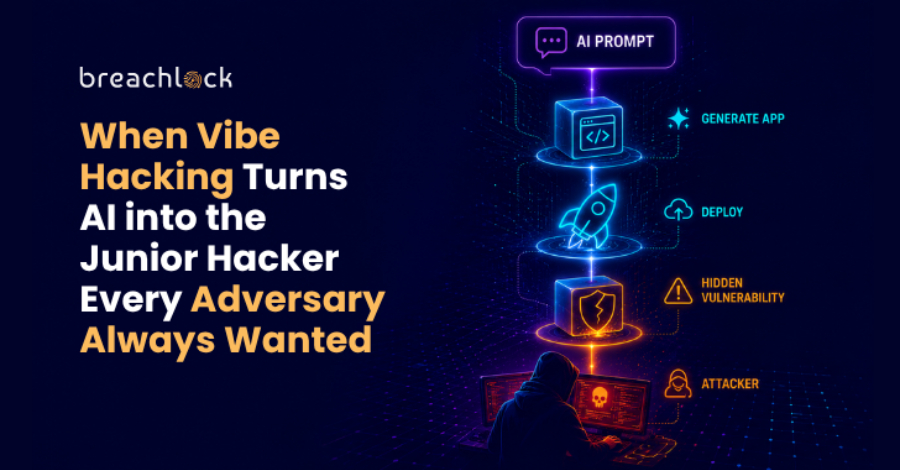
Today's emerging attacker often works alongside an AI assistant, asking iterative questions, refining payloads, debugging code, and adapting techniques to a specific environment. The dynamic mirrors what developers now call "vibe coding," where natural language replaces most of the manual effort behind working software.
Offensive security is starting to see the same shift. Call it "vibe hacking" - the ability to translate intent into effective offensive activity through natural-language interaction with AI.
Whether that label sticks matters less than the trend underneath it. For better or worse, expertise is becoming accessible on demand.
Defense Can't Depend on Attacker Scarcity
Many organizations built their security programs around an implicit assumption that highly capable attackers were relatively scarce. But today, that assumption deserves a second look.
If AI lets more people perform offensive tasks that used to require specialized experience, defenders should expect more experimentation, faster adaptation, and higher attack volume. The question isn't whether attackers have advanced technical skills anymore. It's whether organizations can continuously prove their defenses still hold as attackers become more efficient at reconnaissance, exploit adaptation, and payload customization.
Validation Matters More Than Discovery
Most enterprises already have strong visibility in their environments. Security teams track vulnerabilities and monitor cloud configurations, endpoint telemetry, identities, and third-party risk, backed by attack surface management across dozens of specialized tools.
Awareness was never the limiting factor. Knowing which weaknesses actually matter before an attacker finds them is.
As AI compresses the time between vulnerability disclosure and exploitation, periodic penetration testing and vulnerability scanning stop being enough on their own. Organizations need continuous evidence that critical attack paths stay closed, that compensating controls keep functioning, and that security spending is reducing exploitable risk rather than just generating more findings.
This is the logic behind Continuous Threat Exposure Management: discover, prioritize, validate, and mobilize on an ongoing cycle instead of a point-in-time snapshot. Adversarial Exposure Validation and Penetration Testing as a Service (PTaaS) are how the validation stage actually gets executed, testing the same paths an AI-assisted attacker would try, on the same timeline they'd try them. It shifts the question from "what did we find" to "does this still hold."
Human Judgment Becomes More Valuable
The rise of AI may end up increasing the value of experienced security professionals.
Automation excels at processing information, generating possibilities, and speeding up analysis. Deciding whether a vulnerability represents meaningful business risk is still a human call. It takes an understanding of operational dependencies, business priorities, attacker objectives, and organizational context that a model doesn't have.
The organizations that get this right will amplify human expertise.
The New Competitive Advantage
Every major technological shift rebalances the fight between attackers and defenders.
Generative AI probably won't eliminate the need for highly skilled offensive operators, but it will expand the number of people capable of running credible attacks, while dramatically speeding up how fast they learn, adapt, and iterate.
That changes what defense has to look like. Technical complexity alone no longer discourages adversaries. Resilience now depends on continuously validating security controls, understanding real attack paths, and prioritizing exploitable risk over theoretical exposure.
The age of AI-assisted attackers has already started. It's time to build security programs that can outpace what today's adversaries are now capable of.
About BreachLock
BreachLock is a global leader in offensive security, delivering scalable and continuous security testing. Trusted by global enterprises, BreachLock provides human-led and AI-powered Attack Surface Management, Penetration Testing as a Service (PTaaS), Red Teaming, and Adversarial Exposure Validation (AEV) solutions that help security teams stay ahead of adversaries.
With a mission to make proactive security the new standard, BreachLock is shaping the future of cybersecurity through automation, data-driven intelligence, and expert-driven execution.