tag—Linux
 Microsoft is rolling out Linux container support to WSL
Microsoft is taking Windows Subsystem for Linux beyond just running Linux distributions, as WSL Containers is now generally available.
 Signal adds encypted local backup support to iOS, desktop apps
Signal, the secure messaging app, released version 8.30, completing the rollout of its secure backups feature across all supported operating systems (Android, iOS, Linux, macOS, and Windows).
 New Spectre v2 attack variant leaks Linux root password hash in minutes
A new Branch Target Reuse (BTR) attack has been devised that can recover root password hashes on Intel computers running Linux in 3-5 minutes on average.
 New Spectre-v2 BTR Attack Leaks Linux Memory Despite Existing Defenses
A group of academics from VUSec and Scuola Superiore Sant'Anna have disclosed details of a new Spectre CPU vulnerability variant that affects Just-In-Time (JIT) engines present in web browsers, language runtimes, and the operating system kernel, across multiple CPU vendors. The new Spectre-v2 variant has been codenamed Branch Target Reuse (BTR). "The key insight is that, while modern CPUs
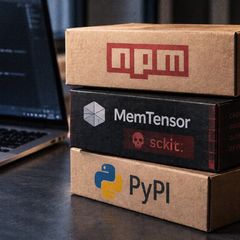 Compromised MemTensor Packages Deliver sckit Credential Stealer via npm and PyPI
Unknown threat actors have managed to compromise two legitimate MemTensor packages across the npm and Python Package Index (PyPI) repositories to push a platform-specific Go-based implant dubbed sckit designed for Windows, Linux, and macOS. According to reports from Aikido, SafeDep, Socket, and StepSecurity, the libraries in question below - @memtensor/memos-cloud-openclaw-plugin versions
 Exploit Released for Unpatched Ubuntu Linux Flaw Enabling Host-Root Container Escape
A use-after-free in the Linux kernel's AF_UNIX socket subsystem can be used to escape a container and gain root on the host, security firm DepthFirst said in research published September 22. The flaw, tracked as CVE-2026-80521 (CVSS score: 7.8), was fixed upstream on August 6, but Ubuntu has not shipped the patch for its 26.04, 24.04, or 22.04 LTS releases. DepthFirst
 New Linux Kernel Flaw Gives ARM64 KVM Guests Read-Write Access to Host Memory
A new flaw in the Linux kernel's KVM virtualization code for ARM64 processors can leave a freed piece of host memory exposed to a guest virtual machine on hosts with nested virtualization enabled. The bug, tracked as CVE-2026-89775, allows a guest to read and write host kernel memory, and the researcher who found it says it can be used to escape the guest and run code on the host machine.
 CISA alerts of active exploitation of three Linux kernel flaws
The U.S. Cybersecurity and Infrastructure Security Agency (CISA) is warning that hackers are exploiting three Linux kernel vulnerabilities, one of them rated critical.
 CISA Flags Three Linux Kernel Vulnerabilities Exploited in the Wild
The U.S. Cybersecurity and Infrastructure Security Agency (CISA) on Friday added three security flaws impacting the Linux kernel to its Known Exploited Vulnerabilities (KEV) catalog, citing evidence of active exploitation. The vulnerabilities are listed below - CVE-2025-39682 (CVSS score: 9.8) - An improper check for unusual or exceptional conditions vulnerability in the TLS receive path
 Public Exploits Released for Four Linux Kernel Flaws That Enable Local Root
A security researcher has released working exploit code for four Linux kernel flaws that each let a local user gain root, the highest level of access on a machine. Kernel maintainers have fixed all four over the past few weeks, so a system running an up-to-date kernel is not affected. But the exploit code is now public, and any machine still running an older kernel should be updated. The flaws
- 1
- 2
- 3
- 4
- 5
- 6
- 28