
OpenAI says it has reduced the price of two GPT-5.6 models, cutting Luna’s API price by 80% and Terra’s by 20% as it works to make its models more efficient.
As per the updated pricing, GPT-5.6 Luna now costs $0.20 per million input tokens and $1.20 per million output tokens, down from $1 and $6.
Likewise, Terra has dropped from $2.50 to $2 per million input tokens and from $15 to $12 per million output tokens.

In a post on X, OpenAI also noted that the new prices affect how it counts usage in Codex and ChatGPT Work.
For example, if new tasks use these models, they deduct less from customers’ allowances, so you can complete more work under the same quota.
OpenAI is also upgrading Auto-review in the ChatGPT app and Codex CLI from GPT-5.4 to GPT-5.6 Luna, which should reduce the cost by approximately ten times.
GPT-5.6 Sol gets a faster API option
OpenAI has also built a Fast mode for API customers, but there won't be any changes to Sol's standard pricing, at least not now.
GPT-5.6 Sol Fast mode is up to 2.5 times faster than standard processing without reducing the model’s intelligence.
The extra performance comes at twice the standard API price, which means it's particularly designed for time-sensitive coding, research, and agentic workloads.
In all other use cases, you really don't need GPT-5.6 Sol Fast mode.
According to the company, GPT-5.6 Sol's recent improvements have allowed it to achieve the efficiency gains behind the Luna and Terra reductions.
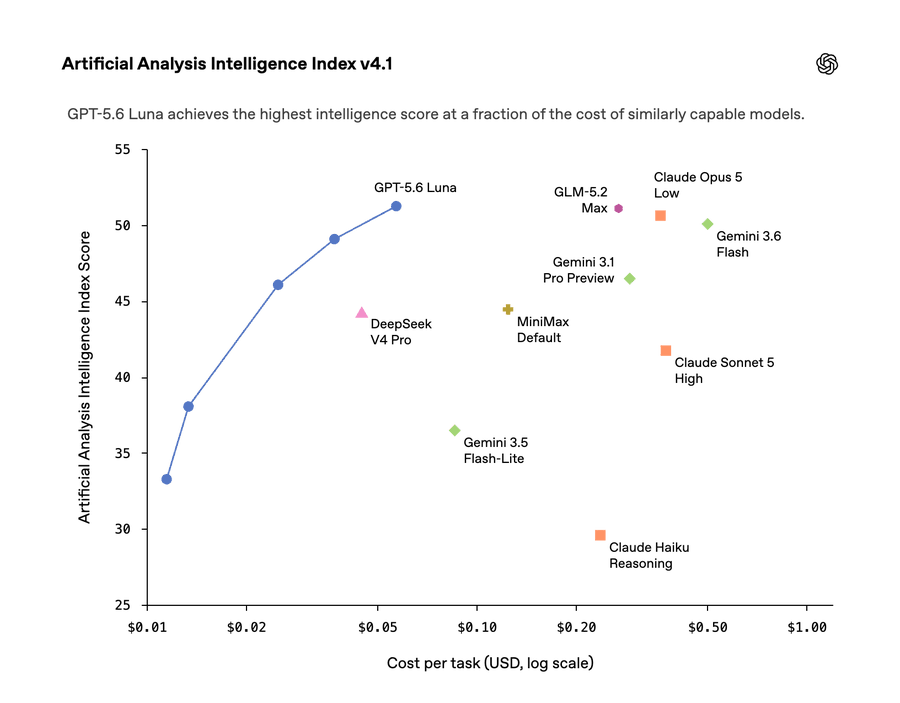
In its own test results, OpenAI also places Luna at the top of its intelligence index among the compared models, despite its substantially lower cost per task.

Test every layer before attackers do
Security teams log 54% of successful attacks and alert on just 14%. The rest move through your environment unseen.
The Picus whitepaper shows how breach and attack simulation tests your SIEM and EDR rules so threats stop slipping by detection.
Get the whitepaper