The SOC we've always known was built around a model that guarantees most of the alert queue will never receive analyst review. There's never time. In a traditional SOC, the typical progression follows a well-known pattern: an alert arrives; a detection engine assigns a severity score. The issue then waits for a human to decide if it should escalate to an investigation.
Given the volume of network telemetry in the security stack, the queue is an unavoidable result of humans as the investigative layer. Long alert queues also force security teams to decide which signals to analyze before they even know what those signals represent.
Threat hunting has always addressed security questions via an alternative approach: start with a hypothesis about attacker behavior, search the available evidence, then prove or disprove it. The sequence is powerful, but it hits the same wall: human capacity.
Agentic security operations change the paradigm.
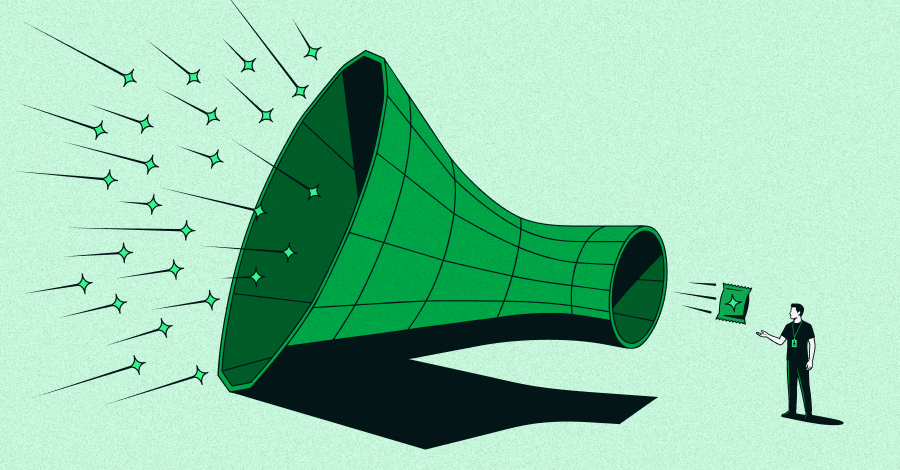
The SOCs now being built are predicated on agentic AI and can conduct investigations faster — in seconds or minutes rather than hours. But increased speed isn't the only shift. The sequence of an investigation also gets an upgrade. Because agents quickly analyze telemetry at volume, they can invert the alert queue model: investigate first, then escalate based on evidence.
Hypothesis-driven investigation, facilitated by AI agents, is an emerging approach to improving detections and reducing the attack surface. A SOC driven by hypotheses (rather than queues) is scalable when it's inexpensive enough to run continuously, moving humans from conducting the investigation to judging its output.
How the inversion works
Agents can investigate as soon as a signal appears: validate the detection, examine the underlying network activity, profile the affected entity, consider historical behavior, correlate related activity, and gather additional evidence from the data.
The investigation no longer must compete for analyst attention. Agents can work asynchronously, pursue multiple investigations in parallel, and return evidence-backed results.
Agentic triage workflows use structured investigative playbooks to examine deep network telemetry and produce verdicts supported by data. This workflow doesn’t only result in faster triage; it means that more signals can be investigated without consuming human resources. The agent removes the manual investigation step, using a broader set of network data before a case reaches an analyst.
Threat hunting at machine scale
The more interesting possibility is what happens before and beyond the alert.
Threat hunting doesn’t have to start with “what was detected?” It can start with “what is the attacker doing?”
Consider these hypotheses. An attacker may be:
- Using an unusual protocol for command and control
- Moving laterally through remote admin services
- Staging data for exfiltration
- Communicating with systems that have no legitimate reason to communicate
- Using a technique designed to stay below existing detection thresholds
Each implies observable behavior. Network traffic provides evidence that can support or contradict the hypothesis, and establish whether a detected signal has real significance.
AI-powered hypothesis-driven hunting doesn’t replace detection; it uses network evidence to test and extend verifiable detections. Network telemetry becomes the foundation of the investigation.
This is what threat hunting looks like when agents can run many investigations in parallel.
Agents can investigate before certainty exists
The real advantage of agentic investigation is that an agent doesn’t need certainty before it starts.
Agentic investigation can pursue a weak signal, test a hypothesis, and stop when the evidence doesn’t support it. The business advantage: it can adjust its hypothesis and repeat the cycle, faster than any human analyst.
An agent can autonomously ask:
- What looks unusual?
- Which relationships warrant examination?
- What evidence supports the hypothesis?
- What evidence contradicts it?
- What additional evidence would reduce uncertainty?
- When has the evidence earned human attention?
The result is an added investigative layer between network activity, detection, and confirmed threats. Most investigations can end without human involvement; the cases that warrant escalation arrive with evidence and context attached.
A higher bar for human time
An AI SOC model looks different from a human-driven SOC. Instead of:
Alert → queue → analyst → investigation → disposition
An agentic alert validation model becomes:
Alert → queue → machine investigation → evidence → human judgment
The traditional threat hunting model looks like:
Telemetry → signal → analyst → hypothesis → investigation → disposition
The agentic model based on hypothesis now is:
Telemetry → signal → hypothesis → machine investigation → evidence → human judgment
Within these new models, the outcome is more investigative coverage without a proportional increase in analyst capacity:
- Lower cost per investigation: agents handle evidence collection and analysis
- Greater threat coverage: the SOC can investigate more potential attack paths
- Faster risk reduction: meaningful threats are surfaced sooner
- Higher-value analyst time: humans focus on decisions, response, and complex cases
- More value from telemetry: security data becomes actionable evidence
Replace the queue with continuous investigation
In AI SOCs, investigation no longer needs to start at the queue. It can start at the signal. Agents will use telemetry to validate alerts, test hypotheses, and follow suspicious activity as it unfolds. Human engagement can be reserved for when an agent returns a case backed by network evidence. In this future, the SOC operates continuous, asynchronous investigations that are evidence-driven and unconstrained by the limits of the alert queue or a human analyst’s time-constrained view.
About Corelight
Corelight provides the network evidence security teams need to detect sophisticated AI-driven threats, agentically investigate incidents, and respond with confidence. Our Open NDR Platform combines high-fidelity network telemetry, multi-layered detection, and AI-powered investigation across hybrid, cloud, and on-premises environments. Learn more about Corelight’s agentic triage here.