
Hackers used a dedicated mobile gateway to compromise a second facility during the destructive cyberattacks that hit Poland's energy sector last year.
The second target was a small combined heat-and-power (CHP) plant that supplies heat to around 50,000 residents, resulting in the steam turbine and the water treatment system being shut down.
The Polish Computer Emergency Response Team (CERT) disclosed this second incident in a follow-up report over the weekend, saying that the attacker used a private Access Point Name (APN) to access the operational technology network.

"The attack was made possible, among other factors, by a misconfiguration that allowed arbitrary devices within the private APN network to communicate with one another."
On December 29, 2025, an attacker believed to be linked to the Russian Electrum threat group targeted 30 wind and solar power installations and a large CHP plant in Poland, destroying key equipment beyond repair.
The threat actor hit distributed energy resource (DER) sites across the country, disabled communications equipment, corrupted operational technology (OT) devices, and wiped Windows systems. Despite this effort to destabilize the grid, energy generation and distribution were not disrupted.
In the newly disclosed attack at a second, smaller CHP plant, the threat actor switched off the programmable logic controllers (PLC) and protected access with a password, thus deactivating a steam turbine and the plant’s process-water treatment system and interrupting cogeneration operations.
The staff at the plant managed to restore impacted systems quickly, so the outage was short-lived and had no impact on the population.
Novel attack path
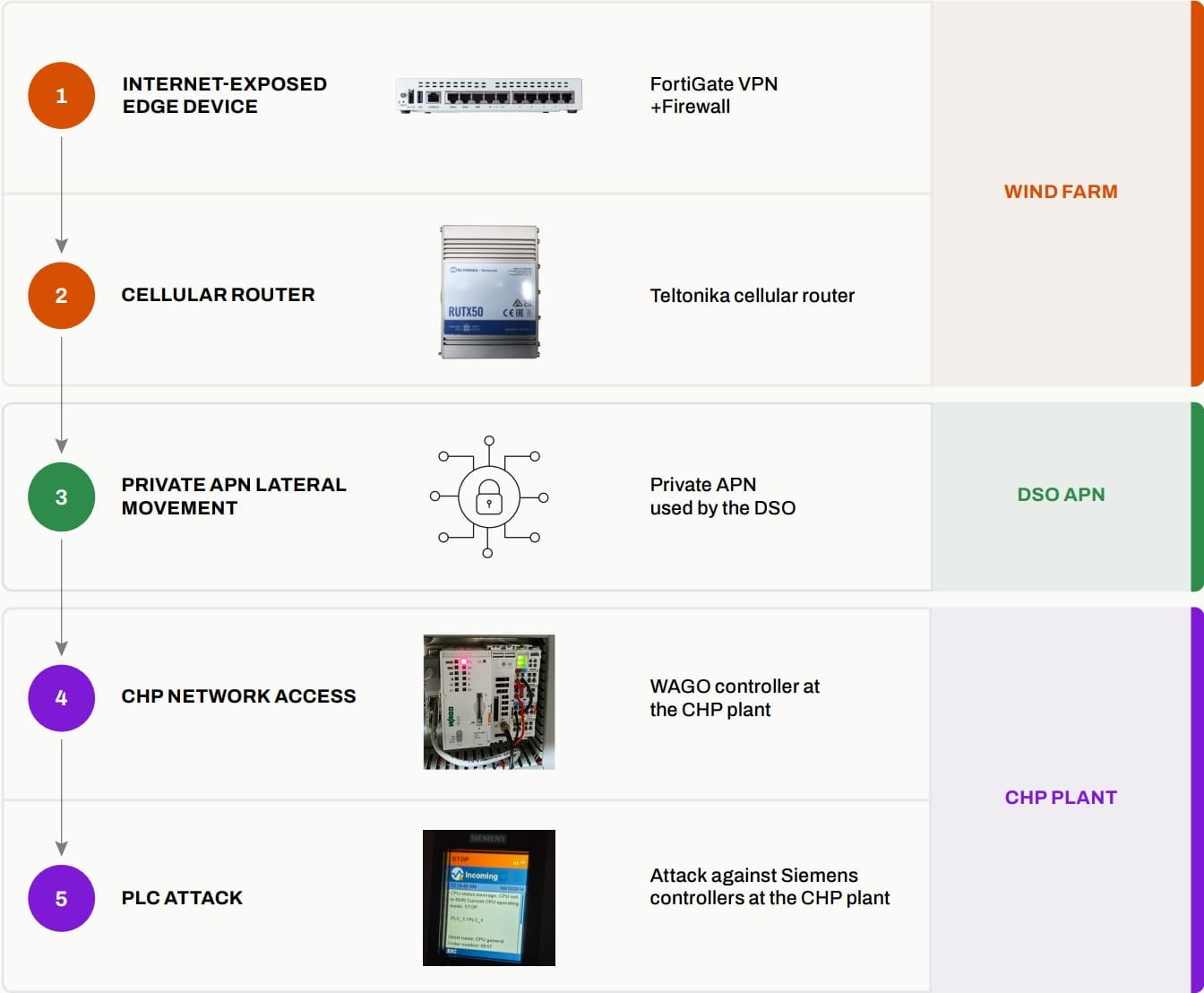
Upon investigating the incident, the Polish CERT determined that the attacker initially compromised a FortiGate VPN/firewall at a wind farm and used a Teltonika cellular router on its network to tunnel into a private APN managed by the distribution system operator.
The APN lacked client isolation, allowing the attacker to scan for and communicate with devices at other facilities.
Beginning on December 18, the attacker found a WAGO PFC200 PLC at the CHP plant whose web interface was exposed on the APN and protected with default administrator credentials.
After compromising the controller, the attacker enabled SSH and used it as a bridge into the plant’s OT network.
Over the following week, they scanned the network for SCADA systems and industrial devices, and on December 25 they connected to three Siemens PLCs, likely in preparation for the attack.
At approximately 5:30 a.m. on December 29, the attacker accessed the SCADA interface and Siemens PLCs, switching them into STOP mode, activating password protection, and shutting down the steam turbine and process-water treatment system.
The attacker also reset and reconfigured several Moxa devices to impede recovery, destroyed logs, and hindered forensic analysis by corrupting or resetting the WAGO controller, Teltonika router, and FortiGate firewall used throughout the intrusion.
The Polish CERT believes this to be the first known real-world cyberattack in which an attacker entered an OT network by moving laterally through a private APN.
“To the best of our knowledge, the incident described in this report, which involved gaining access to an OT network through a private APN, was the first observed instance of this attack vector being used in a real-world cyberattack,” commented CERT Polska.
The surveys that followed the investigation determined that this configuration was common in Poland at the time, and the country's CERT estimates that it's likely similar arrangements are widely used internationally.
It is recommended to treat private APNs as untrusted external networks, enable isolation between connected clients, use allowlists for essential traffic between APN gateways and OT systems, and disable exposed SSH and Telnet administration services.

Test every layer before attackers do
Security teams log 54% of successful attacks and alert on just 14%. The rest move through your environment unseen.
The Picus whitepaper shows how breach and attack simulation tests your SIEM and EDR rules so threats stop slipping by detection.
Get the whitepaper