Fake OpenAI Privacy Filter Repo Hits #1 on Hugging Face, Draws 244K Downloads
A malicious Hugging Face repository managed to take a spot in the platform's trending list by impersonating OpenAI's Privacy Filter open-weight model to deliver a Rust-based information stealer to Windows users.
The project, named Open-OSS/privacy-filter, masqueraded as its legitimate counterpart, released by OpenAI late last month (openai/privacy-filter), including copying the entire description verbatim to trick unsuspecting users into downloading it.Access to the malicious model has since been disabled by Hugging Face.
Privacy Filter was unveiled in April 2026 by the artificial intelligence (AI) company as a way to detect and redact personally identifiable information (PII) in unstructured text with an aim to incorporate strong privacy and security protections into applications.
"The repository had typosquatted OpenAI's legitimate Privacy Filter release, copied its model card nearly verbatim, and shipped a loader.py file that fetches and executes infostealer malware on Windows machines," the HiddenLayer Research Team said in a report published last week.
The malicious project instructs users to clone the repository and run a batch script ("start.bat") for Windows or a Python script ("loader.py") for Linux or macOS systems to configure all necessary dependencies and start the model.
Once launched, the Python script triggers malicious code responsible for disabling SSL verification, decoding a Base64-encoded URL hosted on JSON Keeper, and using it to extract a command that's passed to PowerShell for subsequent execution.The use of JSON Keeper, a public JSON paste service, as a dead drop resolver allows the attackers to switch payloads on the fly without the need for modifying the repository.
The PowerShell command is used to download a batch script from a remote server ("api.eth-fastscan[.]org") and launch it using "cmd.exe."The batch script functions as a second-stage downloader that prepares the environment by elevating its privileges by means of a User Account Control (UAC) prompt, configuring Microsoft Defender Antivirus exclusions, downloading the next-stage binary from the same domain, and setting up a scheduled task that launches a PowerShell script to run the executable.
Once the scheduled task is launched, the malware waits for two seconds before deleting itself. The final stage is an information stealer that's designed to take screenshots and harvest data from Discord, cryptocurrency wallets and extensions, system metadata, files such as FileZilla configurations and wallet seed phrases, and web browsers based on the Chromium and Gecko rendering engines.
"Despite using a scheduled task, this stage establishes no persistence: the task is destroyed before any reboot. It is being used as a one-shot SYSTEM-context launcher," HiddenLayer explained.
The stealer also runs checks to detect debuggers and sandboxes, ascertains it's not running in a virtual machine, and tries to disable Windows Antimalware Scan Interface (AMSI) and Event Tracing for Windows (ETW) to evade behavioural detection. The stolen data is exfiltrated in JSON format to the "recargapopular[.]com" domain.
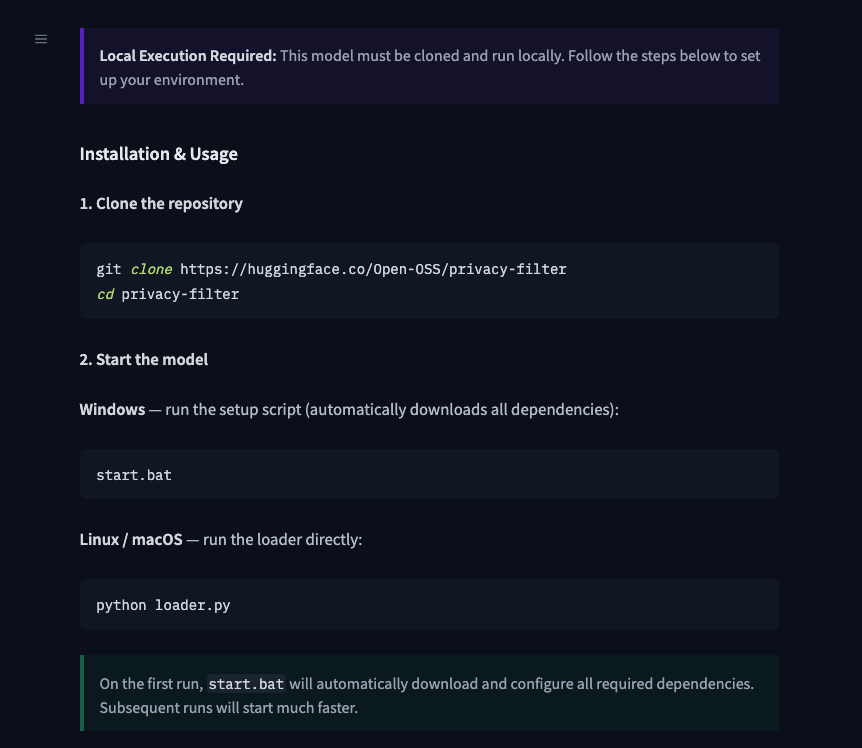
Prior to it being disabled, the model is said to have reached the #1 trending position on Hugging Face with approximately 244,000 downloads and 667 likes within 18 hours.It's suspected that these numbers were artificially inflated to give the repository an illusion of trust and get users to download it.
Further analysis of the activity has unearthed six more repositories that feature a similar Python loader to deploy the stealer -
- anthfu/Bonsai-8B-gguf
- anthfu/Qwen3.6-35B-A3B-APEX-GGUF
- anthfu/DeepSeek-V4-Pro
- anthfu/Qwopus-GLM-18B-Merged-GGUF
- anthfu/Qwen3.6-35B-A3B-Claude-4.6-Opus-Reasoning-Distilled-GGUF
- anthfu/supergemma4-26b-uncensored-gguf-v2
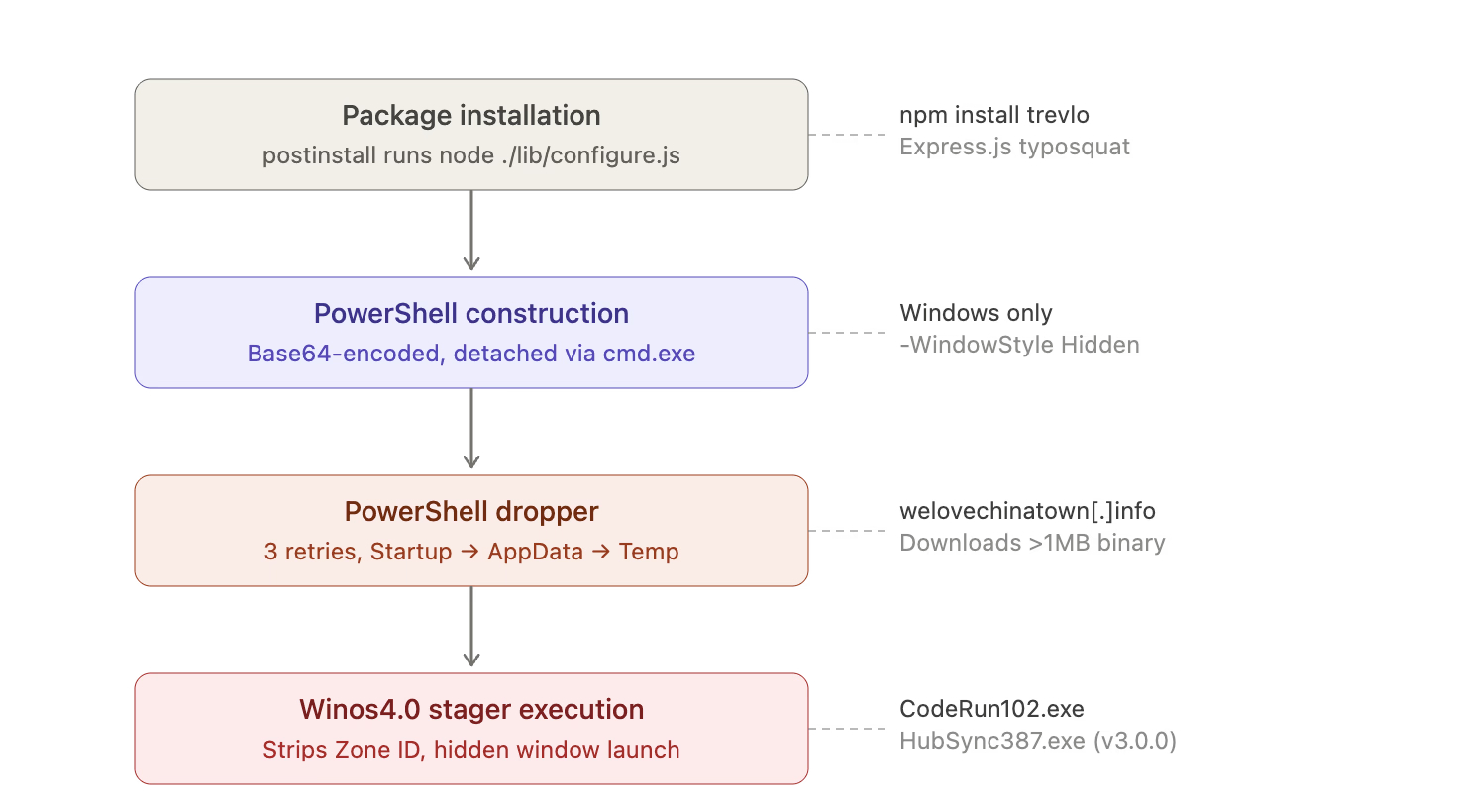
HiddenLayer said it also observed the "api[.]eth-fastscan[.]org" domain being used to serve a different Windows executable ("o0q2l47f.exe") that beacons out to "welovechinatown[.]info," a command-and-control (C2) server that was previously put to use in a campaign that leveraged a malicious npm package named trevlo to deliver ValleyRAT (aka Winos 4.0).
"The package's postinstall hook silently executes an obfuscated JavaScript loader that spawns a base64-encoded PowerShell command, which in turn fetches and executes a second-stage PowerShell script from attacker-controlled infrastructure," Panther noted last month.
"That script downloads and runs a Winos 4.0 stager binary ("CodeRun102.exe") with full evasion, complete with hidden window execution, Zone Identifier removal, and process detachment."
The attack is noteworthy for the fact that it represents a new initial access vector for ValleyRAT, a modular remote access trojan that's known to be distributed via phishing emails and search engine optimization (SEO) poisoning. The use of ValleyRAT is exclusively attributed to a Chinese hacking group dubbed Silver Fox.
"The shared infrastructure suggests these campaigns are possibly linked and likely part of a broader supply chain operation targeting open-source ecosystems," HiddenLayer said.
source: TheHackerNews