
A critical security flaw impacting Rejetto HTTP File Server (HFS) is witnessing active exploitation attempts, according to VulnCheck.
The vulnerability in question is CVE-2026-61500 (CVSS score: 9.3), a case of session forgery stemming from the use of a weak pseudo-random number generator (PRNG) that can lead to a predictable key, which an attacker can then use to gain unauthorized access and seize control of affected systems.
"Rejetto HFS 3.0.0 through 3.2.0 derives its session-cookie signing key from the non-cryptographic Math.random() generator and discloses outputs of the same generator to unauthenticated clients during login," according to an advisory for the flaw.
"A remote attacker can collect a small number of login responses, reconstruct the generator's state, recover the signing key, and forge a valid administrator session cookie, leading to full administrative access and remote code execution via the server_code configuration feature."
Horizon3.ai researcher Zach Hanley, in a post published on September 30, 2026, said Anthropic's Mythos model was used to discover the vulnerability, describing it as an authentication bypass that facilitates arbitrary remote code execution on Rejetto HFS.
"Rejetto HFS's administrative API allows for custom endpoints that can execute arbitrary JavaScript," Hanley said. "Combined, this presented a clear path from unauthenticated access to administrative control, and ultimately, remote code execution."
A patch for the vulnerability was released in July 2026 in version 3.2.1. However, it was not until late September that a Python-based proof-of-concept (PoC) exploit was publicly released by a security researcher named Alejandro Ramos (aka aramosf).
"HFS generated its Koa session-cookie signing key with JavaScript Math.random() and exposed outputs from the same V8 PRNG in the unauthenticated SRP login handshake," Ramos noted. "An attacker can reconstruct the PRNG state, recover the signing key, forge an administrator session, and use the documented server_code configuration feature to execute server-side JavaScript."
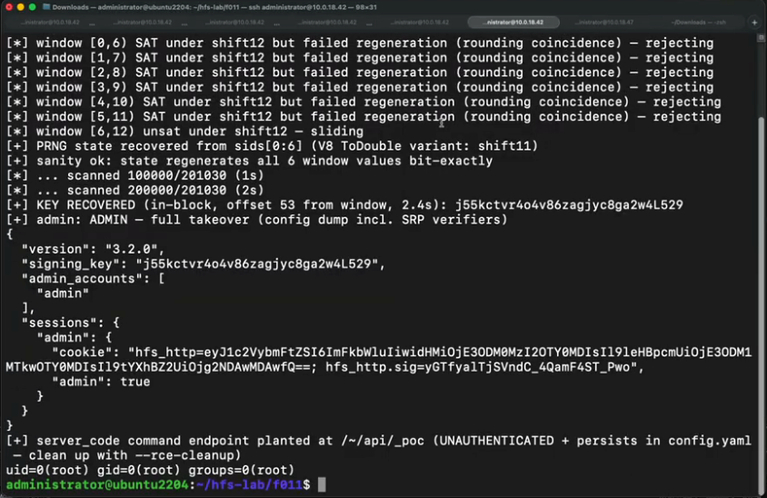
According to VulnCheck's Patrick Garrity, exploitation attempts were detected on October 1, 2026, a day after Horizon3.ai published additional details of the flaw. The cybersecurity company said it identified an unnamed threat actor in China targeting real vulnerable hosts in the U.S.
CVE-2026-61500 is the second vulnerability in Rejetto HTTP File Server after CVE-2024-23692 (CVSS score: 9.8) to come under active exploitation in the wild. In July 2024, multiple threat actors were observed weaponizing the flaw to deliver cryptocurrency miners, trojans, and a malware named HATVIBE.