CWE-22 - Improper Limitation of a Pathname to a Restricted Directory ('Path Traversal')
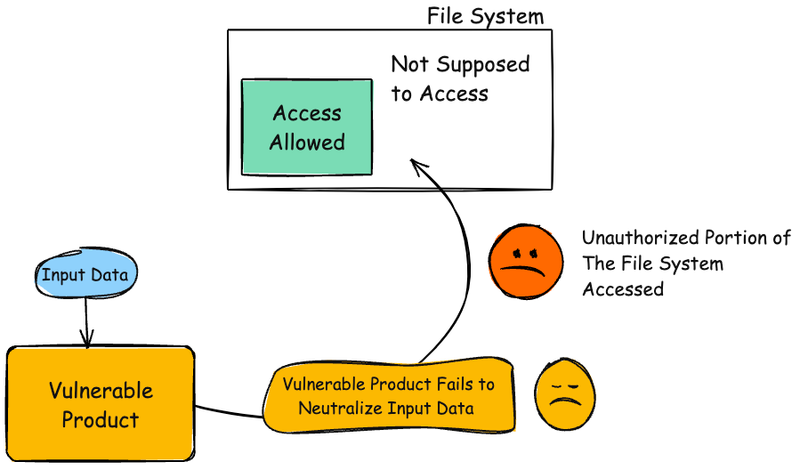
  • 摘要:Base
  • 结构:Simple
  • 状态:Stable
  • 发布日期:2006-07-19
  • 更新日期:2026-04-30

名称

Improper Limitation of a Pathname to a Restricted Directory ('Path Traversal')

描述

The product uses external input to construct a pathname that is intended to identify a file or directory that is located underneath a restricted parent directory, but the product does not properly neutralize special elements within the pathname that can cause the pathname to resolve to a location that is outside of the restricted directory.

Many file operations are intended to take place within a restricted directory. By using special elements such as ".." and "/" separators, attackers can escape outside of the restricted location to access files or directories that are elsewhere on the system. One of the most common special elements is the "../" sequence, which in most modern operating systems is interpreted as the parent directory of the current location. This is referred to as relative path traversal. Path traversal also covers the use of absolute pathnames such as "/usr/local/bin" to access unexpected files. This is referred to as absolute path traversal.

常见后果

范围:Integrity, Confidentiality, Availability

影响:Execute Unauthorized Code or Commands

注释:The attacker may be able to create or overwrite critical files that are used to execute code, such as programs or libraries.

范围:Integrity

影响:Modify Files or Directories

注释:The attacker may be able to overwrite or create critical files, such as programs, libraries, or important data. If the targeted file is used for a security mechanism, then the attacker may be able to bypass that mechanism. For example, appending a new account at the end of a password file may allow an attacker to bypass authentication.

范围:Confidentiality

影响:Read Files or Directories

注释:The attacker may be able read the contents of unexpected files and expose sensitive data. If the targeted file is used for a security mechanism, then the attacker may be able to bypass that mechanism. For example, by reading a password file, the attacker could conduct brute force password guessing attacks in order to break into an account on the system.

范围:Availability

影响:DoS: Crash, Exit, or Restart

注释:The attacker may be able to overwrite, delete, or corrupt unexpected critical files such as programs, libraries, or important data. This may prevent the product from working at all and in the case of protection mechanisms such as authentication, it has the potential to lock out product users.

相关 CWE

相关警报